It's funny how I only blog when I'm really enthusiastic (or really angry) about a given topic.
Which makes me wonder how many steady writers actually feel like writing ALL THE TIME, or if they develop a "get-it-done" mentality to get over the creeping feeling of apathy. Don't they have those same in-betwen moments? Those dry-spells? The dreaded 'white page' syndrome?
I see steady writers blogging about everything and nothing, even a short burst of meaningless ideas or just sharing some links... but always on time. How do you develop that kind of momentum?
What about the need to have something worthwhile to write about. Y'know like... ummm... "not having anything to write about", which is still something to write about.
Or am I just lazy? Might be that too ;)
Catch you when I'm wordier.
Tuesday, May 4, 2010

Monday, April 26, 2010
"Case of the Mondays" Monday Bitchfest Special
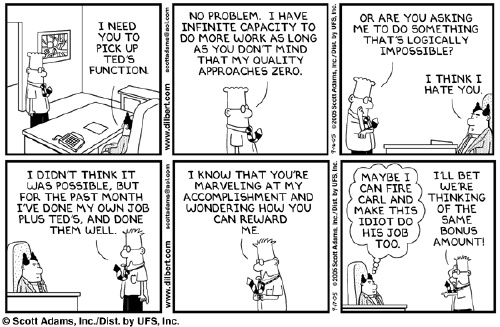
My work ethos is under siege...
It's been a while since I could say I was in trouble with my boss. In fact, I can't exactly recall ever being in 'trouble'. In all previous instances, any 'trouble' was mainly various flavours of 'gentlemanly disagreements', so to speak. But recently things got a little more serious. Serious enough that they had to mention less-than-offhand the thinly-veiled threat of 'disciplinary measures'. In geekier terms: the dreaded banhammer.
I'm guessing the main reason for this is that I'm too casual about everything.
My mindset when I punch in is mainly “Do your work. Don’t show up late. Be nice to colleagues. Endeavour to not daydream too much.” But the Creed also includes some other commandments: “Don’t ever let work get between you and a friend. Don’t bring work home. Don’t let work get in the way of work. Don’t take criticism too personally”.
Just to be clear: this is not my career. There are two reasons that keep me in this job: money and my teammates. I like my salary and schedule well enough (fits the lifestyle) and most of my co-workers are friends I already knew before getting here. This is where my loyalties begin and end in regard to this line of work.
Which means I have no true commitment to the company. Additionally, I always had trouble pushing a product or service I wouldn't use myself, so we're off on a strange footing. The fact that I'm not at all passionate about this work also translates in being detached from it, which means inevitably my mind will wander during my shift. I just can't get 'involved' in the work the same way I would in a more creative job (which is actually a euphemism for ‘interesting but unstable, uncertain, underpaying and resolutely untenable job’).
Errors are common occurrence in an office environment. Most of them are recorded and fixed as soon as they are found out. Where I work, this process is appropriately dubbed 'quality control' and is an essential part of the company's business model. Precision is the main selling point, the care of which falls to we, the operators', hands. Beyond that, there can be the occasional slip up that we don't have time to fix before the clients notice and come calling. That's when the company's reputation suffers.
I'm more than okay with all this. In fact, I support it. When we discover a problem, we fix it instead of denying it. It's great. I'm proud of working for a company that doesn't play ostrich with its own flaws.
I'm a really fast worker. I'm talking Speedy Gonzalez fast here. I clear out more work orders in a week than anyone else in the office. But that also means they can get... well... botched in the process… Sometimes…. Okay. more than 'sometimes', but less than 'often'. The exact figure stands between 8% and 9% errors out of hundreds of work orders per month. Most of these mistakes are corrected before the documents even go live.
I already have my team-lead to go over those with me when they happen. But when work-related issues are deemed important enough to be escalated to a higher level of management, it blows everything out of proportion.
And I don’t mind being told I made a mistake. That’s how you learn. What I have trouble absorbing is the “Hah! Gotcha!” overtones that come out of people’s mouths sometimes. It’s insulting, and it carries the subtle message that they’ll never tire of reminding you about that ‘one time’.
An honest mistake is an honest mistake.
Even a downright stupid one (in my case essentially a copy-paste mistake. I was so hell-bent on obtaining a certain information for the dossier I was working on that I completely forgot to include this other important information, which led to the client noticing said missing information. Emphasis on the client noticing part, because otherwise no one would have made a big deal of it. I would have simply been asked to correct it myself, something I am entirely for - your fuck-up, you fix it).
But corporations are soulless entities. They do not forgive. They do not forget. They do not know empathy. They do not have a sense of humour. They do not know how to deal with employees like me that happen to be human beings first and professionnals second.
But work is serious business.
When you fuck up one task hard enough, all the other trivial things which you thought were perfectly... well... trivial... tend to surface up and bite you in the ass. Meaningless things like forgetting a few minor details here and there, or a harmless and obscure in-joke written by hand in the margins of an old work order. These things, no matter how idiotic and insignificant at the time, have a way of sneaking up on you later on when they suddenly become important. It’s what we get for working in the digital age: not much escapes scrutiny. Stuff that even you forget you did may appear again on someone else’s radar. It’s like the system itself accumulates frustrations and things it can hold against you when you finally push the Wrong Button. Past that particular threshold, be prepared for a shit-storm of little ‘misses’ regardless of your more numerous ‘hits’.
I have no problem ‘fessing up for my mistakes and working to eradicate them. Aiming for the brass ring of “not going to do it again” should be enough of a burden to bear, because this is a performance-heavy job and I need my mental real estate. But being slammed just this once more for the very same issue that was already addressed a week ago sounds like overkill, and only contributes to make me more jaded and depressed about my work. Can’t I just concentrate on not screwing up again instead? I’d love to be able to concentrate, but someone’s trying to guilt-trip me and sadly, it’s kind of working…
Now the hard part.
This is really rough to bring up because I know it will make me sound like a chauvinistic motherfucker (which, you guessed right, I am obviously NOT and do not wish to be associated with). I can just imagine the snipers taking aim, but I have to say my piece.
From my experience (read: from my experience), women in a position of authority have a hard time staying emotionally neutral about it. If you make a work-related mistake, instead of getting an "Uh, okay, so what happened and how can we fix it?", the message they send often is "what the fuck is wrong with you?". If you’re male, the fact that they respond with their emotions (no matter how they try to mask it professionally - which actually shows their level of dedication) will still make it sound to you like a direct attack on your person. I try to not let it show too much, but I'm a deeply-emotional person (they say still waters run deep) and that makes me vulnerable to this kind of assault. That and a propensity for doing everything by-the-book which, sadly, really gets on my nerves (I’ve always postulated that if you always refer to procedure, it only means you can’t think on your feet, but that’s for another debate, and this trait might only contribute to widen the gap between my brand of thinking and the corporate world’s brand of thinking).
My direct superior, (let’s call her A.) is actually very good at suppressing this phenomenon. She's very fair with any and all of her colleagues, and always looking to improve the workflow without sacrificing anyone's sanity. I am insanely glad for that fact. A’s own superior, C., however, is more of a panic-prone, gotta-look-good, middle-management type. Preserving the sacro-sanct Reputation means everything in her job, and I can understand her position well: when nearly the only feedback you get from the office is bad news, it must be kind of nerve-wracking. Also, having to report said bad news upstairs must feel like shoveling shit. So okay, I get it. My little mistake snowballed and made you work twice over. No need to rub my nose in it out of spite. All I should be concerned with is the details of my mistake and how to ensure it doesn’t happen again. And when I’ve gone over that with my direct superior, I sure as fuck don’t need a second lecture from someone else who just got the memo.
I just don’t get how big deals can be made out of little nothings. The moral of the story is probably: never fuck up, no matter how slightly. Also, become a robot. Robots can’t be blamed for their behavior, only their programmers. They also have this cool dance that they do.
Wednesday, April 21, 2010
"Okay with Earth Day"

Eh oui.. j'ai mon ascendant hippy. Je suis un environnementaliste de salon.
C'est-à-dire que je préfère voir la race humaine en harmonie avec son monde: Ni à son service, ni l'exploitant salement. En harmonie veut dire pour moi que nous trouvons les moyens d'occuper la terre et bien y vivre, sans la détruire ni la surprotéger. Jamais vous ne me verrez à une manif', mais jamais vous ne me verrez polluer alors que j'ai des alternatives.
En fait, cette bonne vielle terre se fiche bien de nous. Elle va survivre bien longtemps à l'espèce humaine. Laissons de côté notre nombrilisme d'homo sapiens capitalensis et pensons-y une fois de temps à autre: La terre ne tourne pas autour de l'Humanité.
Je n'aime pas voir les gens prier aveuglément à l'autel de l'environnementalisme. Ça crée des fous-de-Gaia dangereux comme ces horreurs que Greenpeace (passe de cash) et PETA (autre passe de cash), véritables cultes de l'hypocrisie, du "holier-than-thou", dict(ta)teurs de conduite et abuseurs de confiance.
À mon humble avis, ce qui est important pour l'espèce humain présentement est d'améliorer, protéger et partager notre qualité de vie. Ça veut dire trouver des moyens de mieux distribuer les ressources naturelles déjà disponibles, et de s'assurer une continuité en les renouvellant. Au diable vos guerres et vos prises de bec, tant qu'il y a à manger et un toit au dessus de nos têtes.
Autrefois, l'environnementalisme était une cause. Aujourd'hui, c'est une étiquette aussi inutile que les sacro-saintes marques de vêtement (brand names) que vous arborez si fièrement dans la rue en devenant le babillard d'un autre.
Earth... Hour?? HOUR??????
Quand on me propose de participer l'Heure de la Terre, je deviens enragé. Pour ceux qui ne connaissent pas, on demande de couper à zéro l'utilisation de courant pendant une heure par année. Euhhh... wtfQUOI? Selon moi, cette idée est comparable à mettre un vulgaire plaster sur une lacération de 3 pied de long. Pire encore, comme on s'attaque à la consommation d'électricité (le dernier de nos soucis, vraiment), ledit plaster est carrément posé à côté de la plaie...
C'est le genre de mesure temporaire qui fait un pied-de-nez à la véritable cause. Une 'patch' inefficace qui constitue à oublier qu'on a un réel travail à faire si on veut changer quelque chose. C'est comme "becquer-bobo" sur une personne qui souffre du cancer...
Et pour ses pratiquants, eh bien ils achètent une indulgence à l'Église Verte qui est prète à leur pardonner leurs péchés pour une bagatelle. C'est une action qui n'aura servi strictement à RIEN. Allez en paix, comme ils disent...
Je travaille pour une boite qui diffuse des communiqués de presse. On reçoit des compagnies, des ministères, syndicats et particuliers tout plein de nouvelles aussi insipides les unes que les autres et il est de notre devoir de les transférer aux journalistes blasés qui les liront. Si vous saviez seulement le nombre de communiqués vaniteux envoyés par des compagnies et organismes qui se disent 'vert' et qui ne font que parler de leur produits habituels mais cette dans un langage 'vert', ou de leurs 'actions concrètes' qui n'ont aucun impact réel à-part bien sur la récolte de capital politique faux-écolo... vous seriez comme moi découragés de lire toute cette hypocrisie crasse.
Et qui parle d'hypocrisie dit:
Les voitures hybrides...
Quand je vois un de ces véhicules, j'ai le gout d'y mettre le feu. Les voitures dites 'hybrides' sont la pire insulte de l'industrie automobile qui prétend développer une nouvelle voiture du futur, 'meilleure et améliorée' alors que la vraie technologie propre est releguée aux oubliettes en attendant de "voir si le marché est vraiment vraiment prêt pour la voiture électrique".
Mais il l'a TOUJOURS été...
Dans l'ombre, on crée des moteurs électriques de plus en plus viables depuis plus de 100 ans et la voiture électrique n'est pas un rêve distant mais une réalité bien possible... et pourtant, on se contente depuis plus d'un siècle de son petit cousin attardé, la voiture à essence...
Entretemps, on développe des demi-mesures ridicules qui n'ont pour but que de soutirer quelques dinars de plus de la bourse de tous et chacun, question d'étirer la sauce pour l'industrie en place. L'argent parle toujours plus fort que la raison.
Want to 'go green' for real? So stop pussyfooting about it and get to work, you lazy fucks!
*ahem* pardonnez mon gaélique...
Quand je suis plein de café, je réagis plus fort....
Y'a toutes ces choses, mais malgré tout... je suis 'Okay' avec Earth Day
Pourquoi? Parce que le Jour de la Terre est une célébration plutôt respectable qui se perpétue depuis 40 ans et qui amène beaucoup de nouvelles idées, de discussions, de projets et de mouvements pour la conscientisation - bref, de la science pratique. Tout le monde y met du sien et au moins ce n'est heureusement pas uniquement un geste ridiculement futile comme Earth Hour.
C'est 2010, hein? Et bien en 2010 On veut du progrès. Le Jour de la Terre me semble une bonne occasion de proposer des solutions valables. Mes yeux et oreilles veulent être impressionnés. Showtime, les écolos.
Wednesday, April 14, 2010
Emergalv cheapass poetry Wednesday
Her eyes a-piercin’
and circled with blue
Crouch’d in the weeds a-waitin’
o’er the man she’d run through.
Her backbone of stern stuff,
her spear marred with gore,
Her skin look’d as rough
as the leathers she wore.
- Rennald d’Ricvall
From The Southerlands
and circled with blue
Crouch’d in the weeds a-waitin’
o’er the man she’d run through.
Her backbone of stern stuff,
her spear marred with gore,
Her skin look’d as rough
as the leathers she wore.
- Rennald d’Ricvall
From The Southerlands
Tuesday, April 13, 2010
Lecture!
La lecture! Il faut bien en parler, puisqu’elle fait partie intégrante de ma vie depuis que je suis tout jeune (eh oui cette époque a bel et bien existé).
Comme avec tout le reste, mes goûts sont très variés. À différentes époques, j’ai alterné J.D. Salinger (paix ait son âme), Tom Clancy, Weiss & Hickmans, J.K. Rowlings, J.R.R. Tolkien, Frank Herbert, Bernard Weber, William Gibson et G.R.R. Martens et une foule d’autres autheur(e)s, cette liste étant de toute évidence non-exhaustive.
Beaucoup d’excellents livres disparaissent de la circulation, écrasés sous le poids des ‘New-York Times best-sellers’ el-cheapo du mois (fuuuuuuuuuck). C’est dans les brocantes de livres et les friperies, quelques années après leur publication, qu’on trouve les perles rares, les récits oubliés, les vielles éditions (au couvertures souvent plus attrayantes que leurs ré-éditions plus récentes). Je refuse encore de m’acheter les nouveaux formats de Dune, quitte à patienter et me fier au pur hasard pour trouver de vielles éditions. Dans les années 70-80, on faisait avec les moyens du bord, mais on savait faire de la jolie reliure ;)
Certains romans me tombent entre les mains d’une manière totalement inatendue. Je me souviens à l’époque du CÉGEP d’avoir pioché Kindred Spirits (le premier et seul bon volume du Dragonlance Meetings Sextet) pour 69¢ dans un magasin de l’Armée du Salut à Brossard, le tout sur un coup de tête et parce que je n’avais rien à lire au moment de l’achat. Ce coup de tête s’est avéré un bon choix, qui m’a poussé à lire la série au complet par pure curiosité.
Je pourrais dire la même chose pour All Quiet on the Eastern Front (Erich Maria Remarque) et Jarhead (Anthony Swofford), dont j’avais vu les adaptations cinématographiques mais que je ne trouvais pas en étagère. J’ai trouvé les deux à 4.99$ dans un Village des Valeurs, tous deux en excellent état. Il va sans dire que j’ai dévoré les deux dans les semaines suivant mon achat.
C’est dans une brocante de livres nouvellement ouverte à Longueuil que je suis tombé à la fois sur Candideet Cyrano de Bergerac. Idem côté voracité littéraire: je me suis farci ces classiques en moins de temps qu'il suffirait à Cyrano de faire sa tirade du nez.
Quelques mois plus tard, comble de bonheur, je trouve par hasard l’ironiquement excellent Molvania : a land untouched by modern dentistry par Jetlag Travel Guides et ma première copie du The Zombie Survival Guide de Max Brooks. J’ignore quel genre de personne dérangée peut être amenée à se départir d’aussi bons livres, mais je saute sur l’aubaine anyways.
Etc, etc, etc...
À y penser, je dirais facilement que mes meilleures lectures ont été des découvertes impromptues, comme si les livres avaient choisi leur moment pour aparaître sur mon radar. Le fait même qu’elles soient des trouvailles totalement inattendues doit allumer une ampoule à l’intérieur de ma tête qui mèle l’opportunité à la curiosité.
À l’inverse, si j’achète un livre que je prévoyais déjà acheter depuis un bout de temps, ou si je le reçois en cadeau, il risque de se faire oublier dans un coin poussiéreux de ma bibliothèque pendant quelques temps alors que mes lectures dites ‘soudaines’ lui volent constamment la priorité. Étrange, non?
Alors comme avec les rencontres, c’est l’impromptu et le spontanné qui l’emporte.
Allez savoir…
Comme avec tout le reste, mes goûts sont très variés. À différentes époques, j’ai alterné J.D. Salinger (paix ait son âme), Tom Clancy, Weiss & Hickmans, J.K. Rowlings, J.R.R. Tolkien, Frank Herbert, Bernard Weber, William Gibson et G.R.R. Martens et une foule d’autres autheur(e)s, cette liste étant de toute évidence non-exhaustive.
Beaucoup d’excellents livres disparaissent de la circulation, écrasés sous le poids des ‘New-York Times best-sellers’ el-cheapo du mois (fuuuuuuuuuck). C’est dans les brocantes de livres et les friperies, quelques années après leur publication, qu’on trouve les perles rares, les récits oubliés, les vielles éditions (au couvertures souvent plus attrayantes que leurs ré-éditions plus récentes). Je refuse encore de m’acheter les nouveaux formats de Dune, quitte à patienter et me fier au pur hasard pour trouver de vielles éditions. Dans les années 70-80, on faisait avec les moyens du bord, mais on savait faire de la jolie reliure ;)
Certains romans me tombent entre les mains d’une manière totalement inatendue. Je me souviens à l’époque du CÉGEP d’avoir pioché Kindred Spirits (le premier et seul bon volume du Dragonlance Meetings Sextet) pour 69¢ dans un magasin de l’Armée du Salut à Brossard, le tout sur un coup de tête et parce que je n’avais rien à lire au moment de l’achat. Ce coup de tête s’est avéré un bon choix, qui m’a poussé à lire la série au complet par pure curiosité.
Je pourrais dire la même chose pour All Quiet on the Eastern Front (Erich Maria Remarque) et Jarhead (Anthony Swofford), dont j’avais vu les adaptations cinématographiques mais que je ne trouvais pas en étagère. J’ai trouvé les deux à 4.99$ dans un Village des Valeurs, tous deux en excellent état. Il va sans dire que j’ai dévoré les deux dans les semaines suivant mon achat.
C’est dans une brocante de livres nouvellement ouverte à Longueuil que je suis tombé à la fois sur Candideet Cyrano de Bergerac. Idem côté voracité littéraire: je me suis farci ces classiques en moins de temps qu'il suffirait à Cyrano de faire sa tirade du nez.
Quelques mois plus tard, comble de bonheur, je trouve par hasard l’ironiquement excellent Molvania : a land untouched by modern dentistry par Jetlag Travel Guides et ma première copie du The Zombie Survival Guide de Max Brooks. J’ignore quel genre de personne dérangée peut être amenée à se départir d’aussi bons livres, mais je saute sur l’aubaine anyways.
Etc, etc, etc...
À y penser, je dirais facilement que mes meilleures lectures ont été des découvertes impromptues, comme si les livres avaient choisi leur moment pour aparaître sur mon radar. Le fait même qu’elles soient des trouvailles totalement inattendues doit allumer une ampoule à l’intérieur de ma tête qui mèle l’opportunité à la curiosité.
À l’inverse, si j’achète un livre que je prévoyais déjà acheter depuis un bout de temps, ou si je le reçois en cadeau, il risque de se faire oublier dans un coin poussiéreux de ma bibliothèque pendant quelques temps alors que mes lectures dites ‘soudaines’ lui volent constamment la priorité. Étrange, non?
Alors comme avec les rencontres, c’est l’impromptu et le spontanné qui l’emporte.
Allez savoir…
Monday, March 29, 2010
Mercy
Hi everybody and welcome to another edition of The Quiet Alpha. It's been nearly two weeks since our last installment, and what a crazy two weeks they've been! But I'm going to share something today that is a bit out of the ordinary. This is the first in a series of semi-related short stories that will be posted to this blag as the weeks go by and I'm too lazy or distracted to come up with more up-to-date rants.
I present to you:
Mercy
Vohanna looked at the young man. He was sitting down with his back propped against the tree stump, only half-conscious. Bruised but otherwise unharmed, the youth had been taken down early in the fight. Milewe had made sure to drag any weapons away from him, with the exception of a single round shield, the use of which she would make clear to him soon enough.
The Saesar came up behind Milewe and kneeled beside her before the survivor. "Ask him if he knows why we spared him", she offered.
Milewe was about to begin translating when Mucha walked over, shock all but painted on her face. "You speak the language of these swine?", she spat out fiercely.
Vohanna shook her head sadly, rising to meet Mucha at eye level. "We weren't always at war, sora..."
If she still objected, this nevertheless seemed to placate her, or at least let her know there would be no further question of Vohanna’s authority. As she relented, Milewe turned gently to the young Nagled warrior and adressed him in his tongue.
“Mulak-mi anmmah a y?” she attempted, her accented rendering of the foreign tongue making her feel clumsy. Know you the reason why you were shown mercy?
The juvenile only stared at her, his face a mixture of revulsion, fear, and… total incomprehension. She repeated, more slowly, and this time, understanding registered on his features, though the look of hostility remained the same. It was to be expected
“Loa”, he said through clenched teeth. No
“Doesn’t understand, does he?” asked Vohanna, strenly, her hands busy with the cleaning of her spearhead. Judging by her ugly grin, Mucha seemed to relish the idea.
“No he doesn’t.”, confirmed Milewe, pausing to think of her next sentence. “Vi abu”, she motionned to the dead laying all around them. “Palla… a y goa malaat a en. Mulak?” Look around. You must return them to the earth, understand?
She waited. Again, no answer. “Mulak a la?” Do you understand me?
She poked him in the chest, hoping for a reaction, and pointed to the shield laying on the floor, making scooping moves with both hands. “A y goa malaat a en. Dig, damn you”
A single tear welled up in his eye and rolled down his aquiline nose. He lifted his arm to brush it away but the gesture died and his hand fell back to his thigh.
“Naam” he croaked, his skin taut against his cheekbones, defeat marking his every slight movement. Yes
“He gets it.”, said Milewe, finally. She nodded to him pitifully and got up. Vohanna handed her interpretor’s long bow back and gave the order to move out.
The trio left him to get a grip on himself, and dissapeared in the tall grasses where their sisters awaited them.
I present to you:
Vohanna looked at the young man. He was sitting down with his back propped against the tree stump, only half-conscious. Bruised but otherwise unharmed, the youth had been taken down early in the fight. Milewe had made sure to drag any weapons away from him, with the exception of a single round shield, the use of which she would make clear to him soon enough.
The Saesar came up behind Milewe and kneeled beside her before the survivor. "Ask him if he knows why we spared him", she offered.
Milewe was about to begin translating when Mucha walked over, shock all but painted on her face. "You speak the language of these swine?", she spat out fiercely.
Vohanna shook her head sadly, rising to meet Mucha at eye level. "We weren't always at war, sora..."
If she still objected, this nevertheless seemed to placate her, or at least let her know there would be no further question of Vohanna’s authority. As she relented, Milewe turned gently to the young Nagled warrior and adressed him in his tongue.
“Mulak-mi anmmah a y?” she attempted, her accented rendering of the foreign tongue making her feel clumsy. Know you the reason why you were shown mercy?
The juvenile only stared at her, his face a mixture of revulsion, fear, and… total incomprehension. She repeated, more slowly, and this time, understanding registered on his features, though the look of hostility remained the same. It was to be expected
“Loa”, he said through clenched teeth. No
“Doesn’t understand, does he?” asked Vohanna, strenly, her hands busy with the cleaning of her spearhead. Judging by her ugly grin, Mucha seemed to relish the idea.
“No he doesn’t.”, confirmed Milewe, pausing to think of her next sentence. “Vi abu”, she motionned to the dead laying all around them. “Palla… a y goa malaat a en. Mulak?” Look around. You must return them to the earth, understand?
She waited. Again, no answer. “Mulak a la?” Do you understand me?
She poked him in the chest, hoping for a reaction, and pointed to the shield laying on the floor, making scooping moves with both hands. “A y goa malaat a en. Dig, damn you”
A single tear welled up in his eye and rolled down his aquiline nose. He lifted his arm to brush it away but the gesture died and his hand fell back to his thigh.
“Naam” he croaked, his skin taut against his cheekbones, defeat marking his every slight movement. Yes
“He gets it.”, said Milewe, finally. She nodded to him pitifully and got up. Vohanna handed her interpretor’s long bow back and gave the order to move out.
The trio left him to get a grip on himself, and dissapeared in the tall grasses where their sisters awaited them.
Tuesday, March 16, 2010
Billy Idol - Cyberpunk (1993)

I had nothing else to talk about today so I am going with one of my favourite pet peeves with the online community.
Bad press, good karma.
When you listen to Billy Idol's Cyberpunk, you're not really tapping into a musical genre per se: Rather, you are listening to history.
It was one of few commercial rock albums of its time to rely that much on digital means of production. As such, it was panned by more traditionnal rock media as being 'less than genuine', and you'd be hard-pressed to find a mainstream take on this piece that didn't explicitly imply a well-ingrained fear that digital audio workstations with software synths would one day replace instruments and programmers would replace musicians. Being early adopters of the technology working outside of the usual electronic music sphere, Idol and his entourage were pioneers.
Nowadays, when we lay the money down to go see a cyberpunk, postcyberpunk or cyberpunk-inspired work of fiction on the big screen, we can almost always, without question, expect to hear a soundtrack of either electronic, industrial or techno music. Well, it wasn't always this way. There was a time when you could feel 'cyberpunk enough' while listening to rock, dub, jazz, rap, classical music and just about anything that made you think. It was that blessed era that allowed for a variety of styles and the avoidance of an established cliché. It was during those times that, against all (if any) expectation, an already-sucessful, blonde british pop-rock artist decided he wanted to try something different. And try he did.
1993's Cyberpunk has a little something for everyone, granted you have a diverse taste in music. You'll hear straight rock, pop, psychadelic rock, electronica, techno, televised news stories recordings, quotes from movies, gospel and even the kind of new-age relaxation recordings you put on at night to convince yourself you're a perfectly sane human being (just keep telling yourself that, chombatta). This kind of progressive, all-inclusive music collage is a great sign of wide cultural awareness. Coming from a well-known radio-rock musician, this was quite a feat. (In fact, my only personnal gripe is the near-total absence of hip-hop influence, which was already well into crossing over with rock/metal in the early 90s. But, hey, you can only ask for so much.)
As far as concept albums go, Cyberpunk doesn’t as much tell a straigt beginning-to-end story as show you a different time in a different place. It’s an open window on a near-future urban world not too different to our own, just like the books, just like the movies.
It seems to me that, sometimes, reviewers have trouble understanding that an album is more often than not much more than the sum of its parts. In this case, they miss the mark entirely. Cyberpunk attracted a flurry of media attention, oftentimes curious but, sadly, most of it negative. On both sides of the fence, came voices crying foul. The most prominent, oft-cited reason for this is what both the media and internet community interpreted as an attempt to 'cash-in' on an 'emerging trend'. Far from being exclusive to cyberculture, this response is a typical knee-jerk reaction of any cultural group meeting the next generation of enthusiasts, combined with the fear of losing the privileged position as trendsetters. Less hostile, more welcoming members, of course, offered that he was genuinely interested in the themes and ideas of cyberculture and cyberdelic aesthetics. These more compromising voices, were however, drowned out by the naysayers.
If I may offer a little insight, Billy Idol was really on to something. He may have been criticized by both the cyberpunk and rock audiences for attempting to blindly associate himself with the name 'cyberpunk', but he in fact, knowingly or not, perhaps even naïvely, landed himself in the shoes of a Sprawl character wading through a sea of uncertain, possibly dangerous neon-glowing wonders both appealing and terrifying.
Classic cyberpunk fiction often portrays young, inexperienced individuals dabbling in technologies they hardly understand, but which captivates them and is readily available. This naïve fascination often leads to wild experimentation, unexpected accidents, radical changes of personnal lifestyles and the spontaneous birth of new sub cultures. These characters may not know much, initially, but they have the means, and they try their damnedest. This promethean gift to the 'modern primitives' of the cyberpunk world is what fuels most of its science-fiction and ensures the continuous melodrama of man and machine. Analogous to this young cybergeneration, Idol stumbled upon something he liked and could become greatly excited about, despite being tech-illiterate*. Thus, he immediately found himself in a role not unlike that of our young tech-amateurs described above. As a result he is branded as both a newbie and a sellout. Tragic indeed. But you don't get more 'cyberpunk' than being in that specifically uncomfortable position.
* Just a footnote, but does anyone remember the oft-cited anecdote how William Gibson wrote Neuromancer on a Hermes 2000 typewriter? Yeah, I thought I'd mention it.
Musicians let different input sources inspire them. They are not documentary writers, nor are they news reporters or ivory-tower academics. They interpret concepts through their senses, first and foremost. What-you-hear-is-what-you-get.
The same reviewers often place too much emphasis on the business aspect of an artist's body of work. How well did it do? How did fans react? Did it attract a new fanbase? Did it pay for the next album? Did it open new opportunities for the artist? The fact of the matter remains that the album was a whim, an experiment, an envy, a 10-month labour of love, not a career move. No one twisted Mr. Idol's arm and said "well Billy, here's how you tap into this market". He asked around, got some gear setup, sat down with his bandmates and got informed on how to use it creatively.
The cyberpunk genre is characterized by cultural cross-pollinisation, with new subcultures birthed at the drop of a hat, and old, obsolete ideas rapidly replaced. With this mindset, everything is possible and more traditional conventions break down. How can anyone complain about a breach of rules that do not even exist?
Thus, Idol did not embrace a musical style: he embraced an approach.
Is it a good listen? That depends on your tastes. Is it inspired? Definitely. Does it sound like anything else that came out at that time? Nope. Was it genius? Perhaps even not, but it has its controversial place in the hazy spectrum of the 90s ProTools boom, and in cyberpunk history.
Shock the system, baby.
Subscribe to:
Posts (Atom)


